
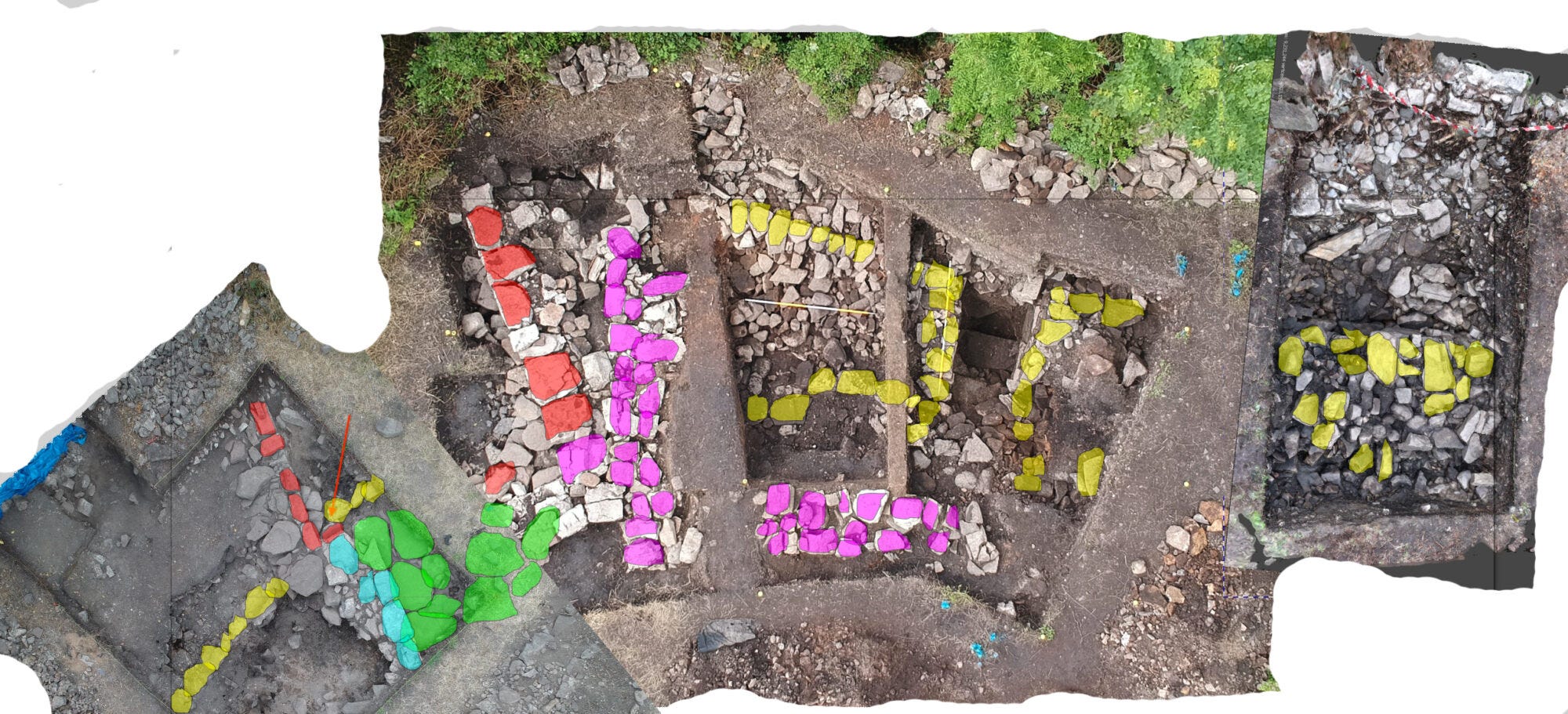
Sometime in the eighth century, at Kilteasheen, near Lough Key in County Roscommon, a couple of odd burials took place. At different times but in the same spot, two men were buried with large stones forced into their mouths. In one of them the stone was wedged in hard enough to have very nearly put his jaw out of joint. One was an old man, the other a young adult. A dig in the area led by Chris Read of IT Sligo and Thomas Finan of Saint Louis University found their bodies among more than a hundred and thirty skeletons buried there. Read has called it the only find of its kind recorded in Ireland so far.
Why would anyone want to shove large stones into the mouths of corpses? The short answer is probably because they wanted to shut them up, ensure they wouldn’t try to eat anything (like blood), and stop them getting back up out of their graves. Back in eighth-century Roscommon, it seems, there were people who did not trust these particular dead men to stay dead.
The bodies that people fear
Based on their unusual or deviant burial, these men may have been believed to be revenants, that is, dead people who didn’t stay dead but came back after burial, hungry or vengeful or maybe both. It’s a common European belief and may have been fed by unusual post-mortem bodily happenings. The same body that comforted everyone in life could provoke horror once dead. The face you loved sometimes becomes a face you can’t bear to look at. Perhaps the person died of some terrible or disfiguring illness, and the change in death could become so total that an altered physical state read, to a frightened family and community, as an indicator of malign activity or intent rather than simple decay.
In a good number of medieval European stories, the dead who come back are the ones whose deaths were sudden, violent, or otherwise left socially unfinished. A death that came without warning, or with sins unconfessed, left the boundary between living and dead feeling unsealed. And unsealed doors let the dead back in…
Or the fear may have been due to the fact that the dead were outsiders, or chronically ill in a way no one could understand properly. Or perhaps they lived socially unsanctioned lives. There are so many ways in which human beings can show their distaste and disdain for their contemporaries. And so those who were unacceptable in life were often painted that way in death too. They might be laid face down although, to confuse things slightly, that could also indicate some performative humility on the part of the deceased. But some of these burials, at least, look like an attempt to control or contain a dead person thought to be dangerous.
What people actually saw
A great deal of fear around the returning dead may have begun around bodies that simply weren’t behaving as expected. Bodies sometimes decompose in ways that can cause unease or fear. A corpse can swell as gases build up, the skin can darken, things can shift, and fluid escapes from the mouth or nose that can look, disturbingly, like blood. The horror people felt was real, because some bodies really did change shape and colour, sometimes within days. So the stories people wove about the dead returning, about bad deaths, violent ones, suicides, drownings and such like, about those who met their ends messily or tragically or both at once, were the tools they had for making sense of a change nobody had the biology knowledge to explain. A death that came in some unusual or frightening way could mark a person, in the eyes of their community, as spiritually unsettled and so at risk of coming back.
One recent study asked exactly this question, of who gets a deviant burial and why. At Drawsko in Poland, several bodies were buried with sickles laid across the throat and stones wedged under the chin, presumably to stop them rising. One guess as to the reason why was that these were outsiders: incomers the community mistrusted, or people who’d offended or attacked someone. This didn’t hold up though when they carried out isotope analysis of their teeth because that showed that their strontium signatures matched the local area, so simple foreignness wasn’t the reason they ended up under a sickle. Whatever marked them as dangerous, it wasn’t being from elsewhere. The study, of course, couldn’t pin down exactly what that was, only that one of a number of possible issues including their social identity, manner of death, a disease, or some local suspicion specific to those people was the likely cause.
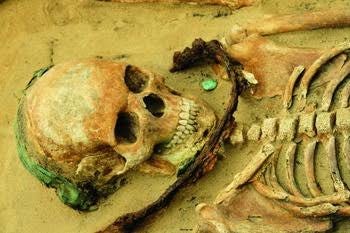
But (and it’s a big but) as I said, a deviant burial isn’t always a bad thing. Sometimes it marks elevated status, someone buried unusually because they mattered and not because everyone was afraid of them. But burials that have stones forced into the mouth, for example, do seem tied to some deviation from the norm, whether in how the person died or how they’d lived their life. These were the ones most at risk of popping back after death. Nobody wanted that.
The hungry dead of the parishes
When people believed the dead returned, their stories name the fear. Bob Curran gathered a selection of these traditions for History Ireland some years ago. From Drimoleague in County Cork, there’s the story of a dead man named Michael Derrihy who comes back and forces a young girl to carry him on her back around the countryside while he goes house to house, slitting the throats of sleeping people with a razor and mixing their blood with oatmeal to eat as he goes. Curran thought the blood-and-meal detail probably has roots in the hunger of Famine-era Ireland. Michael Derrihy isn’t just evil. He’s eternally hungry in a very particular, very sad, and historically understandable way, which is worse.
In Knocklayd, women come back from their graves threatening to eat their relatives out of house and home. Near the Arney river in south Fermanagh, dead women return trying to take small children away with them, tapping at the windowpanes at night with long fingernails. Both are examples of a rapaciousness evident in the unholy dead, the opposite of the nurturing, motherly ideal. In the Dublin mountains, a dead priest comes back to threaten his own mother, meaning to drink her blood, and is stopped (by a locked door). These stories name a dread, a world where the restless, hungry, recent dead are assumed to want something back from the living. Their blood, or their food, or their child.
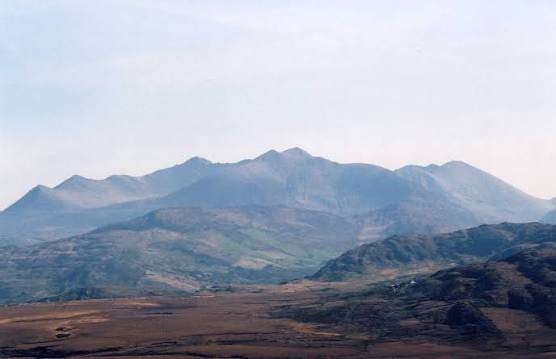
In Kerry, Tadhg Ó Murchadha, collecting for the Irish Folklore Commission in Sneem in 1937, wrote down tales of blood-drinking, flesh-eating ghouls in some detail. In a 1961 lecture, Seán Ó Súilleabháin mentioned a place he called Dún Dreach-Fhoula, the Castle of the Blood Visage, said to sit high in the mountains called MacGillycuddy’s Reeks and home to blood-drinking fairies who preyed on travellers through one mountain pass. He never gave a location for it, and none has been securely identified since. Maybe that’s for the best. It sounds like the plot of a decent folk horror film.
But there are other places where the returning dead seek to slake their thirst. Carrigaphouca near Macroom is haunted, local tradition says, by a blood-drinking spirit possibly once Cormac Tadhg MacCarthy, remembered locally as someone who sold his kinsmen to the English. The legend appears to have attached itself to a real MacCarthy lord tied to Crown service (more on the naming tangle below). At Leap Castle in Offaly, (a hub of supernatural activity I have written about here) the story is of a nobleman, Tadhg Caoch O’Carroll, who cut down his own brother, a priest, across the altar rails of what’s still called the Bloody Chapel, and he is still there as punishment, feeding on whoever comes too close. Curran notes that both men were sometimes called “derrick-dallys” locally, which would seem to be an Anglicisation of dearg-diúlaí, blood-drinker.
The abbess who wouldn’t age
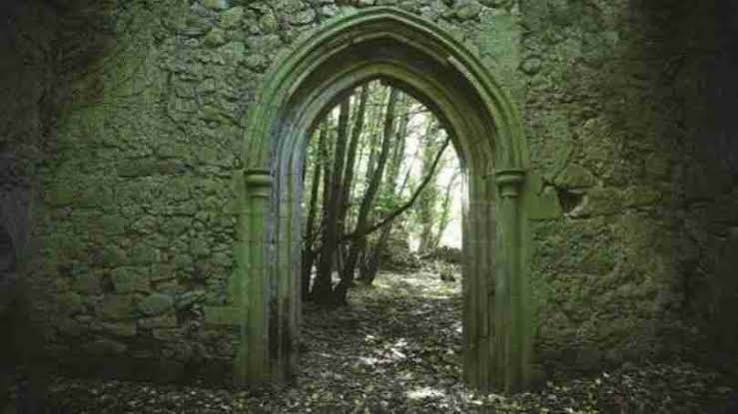
While some monsters began as warriors or fairies there was one who began life as an abbess. At the ruins of the nunnery of St Catherine’s in Shanagolden, County Limerick, there is a strange story told about a woman of the FitzGerald family. She was an evil abbess who drank the blood of her novices to stay young. She was a witch too (I mean, why not?), and a “cup tasser,” a prophetess the local nobility consulted before deciding whether to go to war. She has been dated to the late sixteenth or early seventeenth century. Archaeological survey work at the site has confirmed St Catherine’s as a real nunnery and identified the so-called Black Hag’s Cell as probably a fifteenth-century anchorhold, a good century or more before the abbess supposedly lived there. The legends are many about her, this last abbess who probably once ran a tight ship.
Tradition tells various tales about the locality. During one of the many wars between the FitzGerald earls of Desmond and the Butler earls of Ormond, an Earl of Desmond was trapped in a nearby castle everyone assumed was impregnable. It falls anyway, because his own harper lets the besiegers in through a postern gate, having struck a private deal to be ranked above his master once the dust settled. The Butler commander, once he was in then hung the harper from the battlements. I dare say the commander found it funny.
In the chaos the Desmond Earl gets away on horseback with his countess. A Butler soldier spots them, looses an arrow meant for the Earl, and it passes over his shoulder and kills his wife instead. He carries her body through the nunnery’s South Gate and has her buried, in haste, under the altar of the chapel, then rides on. One version of the legend says she wasn’t dead at all, that she’d been buried alive, and that it’s her ghost, not any abbess, haunting the ruin ever since. Utterly grim.
Another story skips the siege altogether and blames the abbess herself. Before the Reformation, it goes, the Pope dissolved the nunnery over her conduct: she was a FitzGerald who’d taken up witchcraft and fortune telling, and the local gentry are said to have consulted her before riding out to battle. When her nuns scattered, she stayed on alone, living out her days in the little room off the church still known as the Black Hag’s Cell. She grew very old, old enough, people said, that her face turned mottled, and those who spotted her gathering herbs in the fields kept their distance. She was found dead one morning, in front of the small door that led from the church into her cell.
Nobody seriously thinks a real abbess drank human blood. The legend may show how the memory of a female religious superior was transformed, after the abbey’s abandonment, into a story about witchcraft, unnatural longevity, and blood-drinking. Or it is, somehow, about an unfortunate woman who was buried alive. Maybe the tales are, in an oblique way, touching on the fear an old woman felt when her home was taken from her, and on the desperation of women left to fend for themselves in a former nunnery. What I do know is this.. When it’s remembered without its institutional frame, their female authority became, very quickly, something weird and very dark.
These tales show how easily local memory turns hunger and grief or just someone who didn’t fit in into something recurringly unnatural. Perhaps some of the stories can be read as a later imaginative processing of Famine-era hunger and trauma, or they may reflect the memorialisation of other hard times across the centuries. As we know, Irish history is not always exactly a bed of roses. The Roscommon skeletons show that sometimes the fear and body horror got answered with a stone and a shovel instead of a story, an entirely practical response. The Black Hag shows a woman’s power, or perhaps her vulnerabilities, curdling over time into something the parish decided to call monstrous. Perhaps, when we think of how memory reshapes people and their history it is not the restless dead we should fear but the living people who once decided on who was acceptable and who was not.
And if you liked this then please do read this one on the making of an Irish vampire.
Further reading
Institute of Irish Archaeology, Lough Key Archaeological Project (Kilteasheen excavation pages), and “Medieval Irish Had Their Own Ways to Stop the Undead,” Medievalists.net, 16 September 2011. On the 2005–2009 Roscommon dig, co-directed by Chris Read (then IT Sligo) and Thomas Finan (Saint Louis University).
Nancy Caciola, “Wraiths, Revenants and Ritual in Medieval Culture,” Past & Present 152 (1996), and Afterlives: The Return of the Dead in the Middle Ages (Cornell University Press, 2016). Mostly continental evidence, postdating the year 1000, used here for comparison rather than as direct evidence for eighth-century Ireland.
Jacqueline Simpson, “Repentant Soul or Walking Corpse? Debatable Apparitions in Medieval England,” Folklore 114, no. 3 (2003): 389–402.
Paul Barber, Vampires, Burial, and Death: Folklore and Reality (Yale University Press, 1988), esp. chaps. 8–9.
Lesley A. Gregoricka et al., “Apotropaic Practices and the Undead: A Biogeochemical Assessment of Deviant Burials in Post-Medieval Poland,” PLOS ONE 9, no. 11 (2014)
Bob Curran, “Was Dracula an Irishman?,” History Ireland 8, no. 2 (Summer 2000): 12–15.
On Carrigaphouca’s MacCarthys: Bob Curran names the blood-drinker “Cormac Tadhg MacCarthy.” A real Sir Cormac MacTeige MacCarthy, 14th Lord of Muskerry, died in 1583 and served the Crown. But the refuge-and-pardon story tied to Carrigaphooca (fleeing there after Kinsale in 1601, later pardoned by Elizabeth I) belongs, by most accounts, to his nephew Cormac MacDermot MacCarthy, the 16th Lord, himself sometimes recorded as “Cormac Teige MacCárthaig.” Gaelic patronymic naming repeats first names across generations, so we can’t state definitively which MacCarthy the legend actually means.
John Wardell, “The History and Antiquities of St Catherine’s Old Abbey, County Limerick,” Journal of the Royal Society of Antiquaries of Ireland, 5th ser., vol. 14 (whole-series vol. 34) (1904): 41–64, esp. p. 51.
Tracy Collins, Female Monasticism in Medieval Ireland: An Archaeology (Cork University Press, 2021).
Fascinating read, thanks for sharing! I remember encountering those eighth-century deviant burials in a documentary some time ago, and I’ve been intrigued by them ever since.
I so enjoyed every word of this. Now my mind lingers on the image of Emily Brontë’s father, or perhaps her paternal uncles from Fermanagh, handing down the story of dead women tapping on windowpanes at night with their long fingernails, and of her drawing inspiration from that. And while I am aware that Bram Stoker named Dracula after Vlad the Impaler, I can’t help drawing a comparison with the placename Dún Dreach-Fhoula.