
The Banshee
Ireland’s Death-Messenger
Do you have a family banshee story? We do and I can’t remember when I was first told it but it is a tale told by my otherwise very rational Dad that has never altered. He still swears blind it happened to him as a small boy. He was carrying scraps to feed the pigs when he met an old woman on the road, combing her long grey hair. She was pleasant and friendly. She knew his name, and she asked after his family because she knew their names too. While he was chatting to her his uncle walked past and told him to get a move on. Later my Dad asked his uncle if he’d recognised the woman they’d been talking to. The reply was, “What woman?” That story has been family folklore ever since. My Dad met the banshee (“a genuinely nice old woman”) and to this day he swears he met her, combing her hair and chatting away on the side of a Dublin road many years ago.
I’ll come back to my Dad and the banshee in a bit. First, let’s talk about who that woman on the road represents, because she’s older and stranger than many people realise.
Who and what is she?
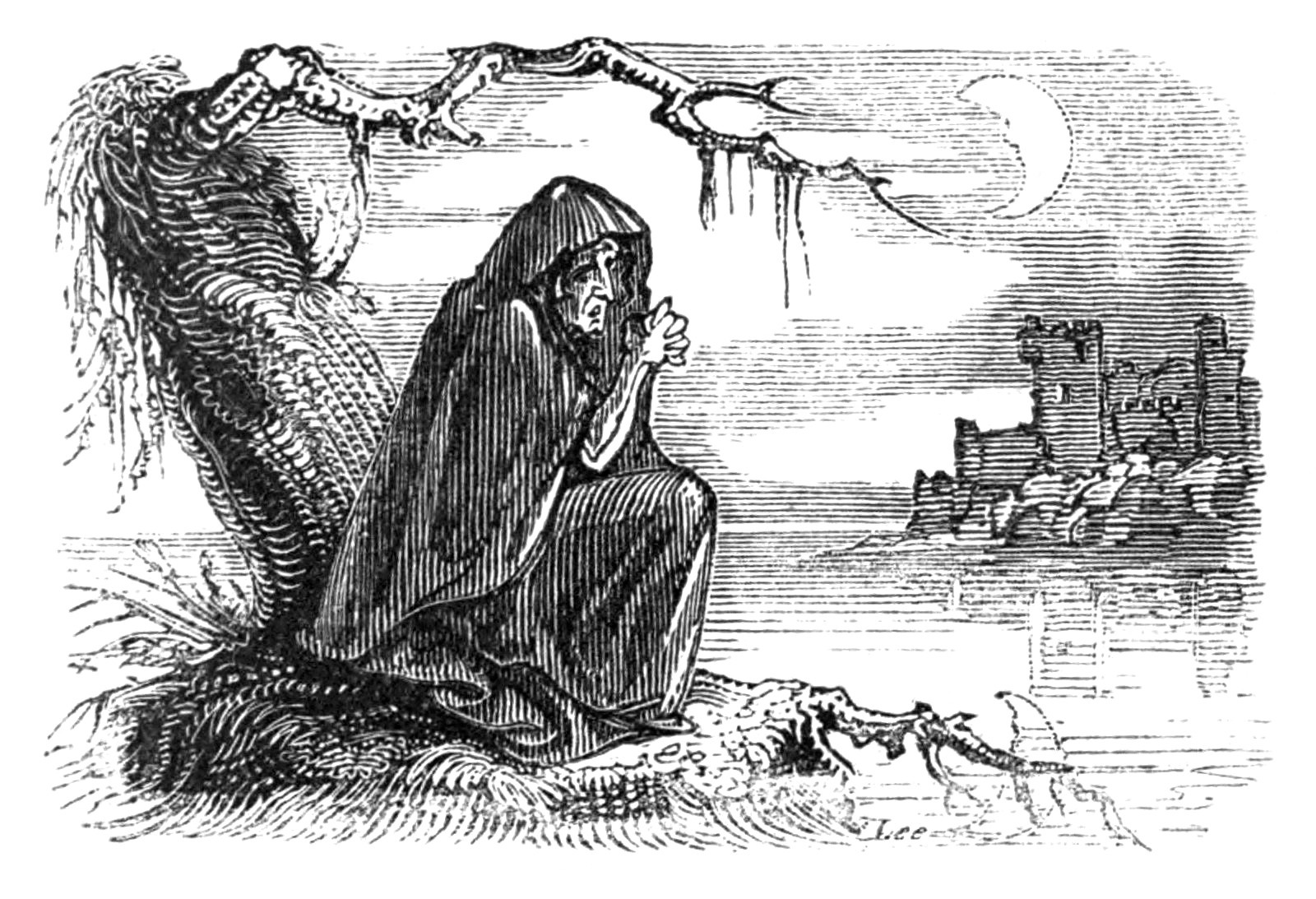
The banshee is female. There’s no male equivalent, no counterpart who turns up to herald a death in a man’s voice. You can hear that she’s a woman in the name itself, which comes from the Irish bean sídhe or bean sí, from the Old Irish ben síde. It’s usually translated as “fairy woman,” though “woman of the mound” or “otherworldly woman” is closer, since sídhe can mean either the fairy mound or the otherworld itself.1 And yet she doesn’t behave as other fairy women do in the tales. She doesn’t meddle in human affairs or appear to tempt men, or turn up unexpectedly in company. She keeps to herself. Patricia Lysaght, the expert folklorist who knows more about her than anyone, calls her not a fairy woman but a death messenger, a supernatural figure who stands outside the usual run of otherworldly people in Irish myth.
She’s supernatural, but she has a job, and that job is to announce an approaching death, usually by crying outside the house of the doomed. She is heard by the locals thus giving friends and neighbours a chance to organise and give support to the family who would soon experience a death.
That’s the right framing, and it fixes the logic cleanly: the Washer is the old battlefield tradition, the banshee is what it eventually softened into, and the bridge is the shared job of marking death. Here’s a redraft of the paragraph that does the bridging rather than just asserting the link.
She’s also genuinely old, or at least the tradition she comes from is. Behind the banshee stands an older figure, the Washer at the Ford: a supernatural woman found at a river washing the bloodied gear, or the innards, of men about to die. The standard story she inhabits is that of a warrior on his way to battle meets her, asks whose arms she’s scrubbing, and she gives his own name. One of the earliest datable traces of her is in Reicne Fothaid Canainne, a poem Kuno Meyer dated on linguistic grounds to either the eighth century or the late ninth to early tenth.
In it the war-goddess the Morrígan washes the huge entrails of the slain, flinging her hair back and laughing as she works. Kristen Mills reads this as one of the oldest surviving instances of the washing figure, though she notes that the Morrígan here washes men already dead rather than warning of a death to come, so the scene may not yet carry the premonitory charge the motif took on later. What links this battlefield goddess to the banshee of later times is not the washing or the gore, both of which fell away over the centuries, but the one thing that survived the journey: she marks a death. The Washer warns the warrior at the ford and the banshee cries outside the house. Over a very long time the first slowly became identified in many times with the second.
One of the earliest sustained accounts of another such creature comes from the Cathréim Thoirdhealbhaigh, the Triumphs of Turlough, a war-history composed around 1350 by Seán Mac Craith, hereditary historian to the O’Briens of Thomond.2 On the army’s march to battle in 1317, the O’Brien leader meets a hag washing the mangled heads and limbs of the slain on the shore of Lough Riasc. He asks whose they are. She tells him she is the Hag of Black Head, that the heap is his own army, and that his head lies in the middle of it; she has come, she says, on behalf of the rival Clan Turlough.
She is not, in this text, quite the banshee of later folklore either but she is on her way to it. Patricia Lysaght reads the Cathréim as a late and heavily stylised work in which two older figures are being drawn together: the badb, the war-goddess who glories in the slaughter, and the standard sí-woman, the otherworldly female of the mounds.3 By the fourteenth century the war-fury was fading and the washer at the ford was sliding towards the death-messenger we’d recognise today, attached now to a particular family and its fortunes rather than to battle in general. So the hag of Lough Riasc is transforming: still half war-goddess, already half banshee.
The same text gives her a mirror-image scene a year later. As Richard de Clare's army nears the river Fergus before the battle of Dysert O'Dea in 1318, they find a badb at the ford washing bloodied armour and fine robes until the water runs red. De Clare sends a man to ask whose they are. They are his own, she says, and his son’s, and most of his retinue's, and most of them will shortly be dead. She gives her name as the Water-Dismal One. De Clare tells his men to pay her no heed: she has come, he says, for the other side. He is of the English in Ireland but he recognises what she is.
He was also wrong. She was indeed there for him, his son and many of his men.
Such knowledge of these otherworldly figures eventually declined. When the Department of Irish Folklore at University College Dublin sent a banshee questionnaire (yes, brilliantly it happened) to around 150 correspondents across Ireland in the mid-1970s, Bo Almqvist, noted that what had been written on the subject up to then was thin and rested on insufficient knowledge.4
County by county
Ireland is small, but there was never just one type of banshee. Ask people in different parts of the country and you’d get genuinely different creatures answering to the name.
In the southeast, along the Leinster and Munster border , she’s often called the badhb, a name that links her to Badb, that early Irish war-goddess who announced death in the form of a scald crow. In those areas she can be young: tall, beautiful, golden-haired and dressed in shining white. That’s a long way from the version most of the rest of the country reports, where she’s a small, decrepit old woman with grey hair, the hag or cailleach type, looking every bit of her years. Some folklorists have wondered whether the haggard look is actually the later version, surfacing around the seventeenth century when Ireland, exhausted by centuries of atrocity and with no faith any more in its gods and monsters, constructed a less radiant version of her. Perhaps the radiant goddess version hangs on in the badhb districts like a vestige of something much older. In parts of Leinster she’s the bean chaointe, the keening woman. Cross the water to the Scottish Highlands and her cousin, the bean nighe, the little washerwoman, does her work at the river instead, scrubbing the bloodied clothes of the soon-to-die.
In some places the tradition thins out almost to nothing. When Thomas Johnson Westropp gathered folklore along the Connacht coast in the early twentieth century, he found no outstanding named banshee there to match the famed Aibell, Áine, or Clíona in Munster. He even noted that some people muddled the banshee up with the Púca (a mischieveous spirit).5 Her activity is not, in other words, evenly spread.
The comb detail which so many people know about her belongs mostly to Leinster, which is, as it happens, where my Dad is from.
The comb, the hair, the cry
Combing comes up again and again, and nobody’s entirely sure what it means. In Irish myth, combing the hair is something that supernatural women do; Boann, goddess of the Boyne, among them. It may be no more than visual shorthand for “not of this world.”
The main thing to remember about the banshee’s comb is to leave it alone. There are many versions of a tale where someone picks up the banshee’s comb and finds her at the window that night, wanting it back. The trick is never to hand it over directly. You pass it out on the iron tongs from the fire, iron being the old protection against the fairies. She takes the comb, twists or snaps the tongs for good measure, and stomps off into the dark. The lesson is plain enough: that would’ve been your hand. Don’t interfere with the banshee. Leave her alone and she won’t physically interfere with you. Annoy her, and prepare for retribution. If you see a comb on the ground, walk right on by.
A story written down in the 1930s from Mrs Ellen Langan of Rathowen, Co. Westmeath, tells of other physical harm thanks to the banshee:
“The tailor used to be making clothes for the Donore people and the banshee used to come in and cry when any of them would be going to die. The tailor said if she came in this time he’d shut the door and make her talk (it seems they were expecting a death). She did come. He shut the doors and spoke to her but she wouldn’t answer. He then started to look at her. She stuck her fingers in his eyes and went out. In about ten minutes he lost his sight. The banshees used to cry about it after but they never went in after that”.6
Not every area talks about the comb, but everyone talks about her hair. However she looks, young or ancient, her hair is the constant: long, often grey, sometimes trailing to the ground, and always uncovered. The detail is old. The hag of the Cathréim wore her hair
"thatched with elf-locks, foxy grey and rough like heather, matted and like long sea-wrack”
which is already, in the fourteenth century, the loose wild hair the folklore collectors would write down six hundred years later. That bare-headedness is telling. At Irish wakes, older women would take off the head coverings they wore in daily life and loosen their hair to keen the dead. The banshee, in other words, is dressed for grief. The same loosened hair marks the Morrígan in Reicne Fothaid Canainne. Lysaght connects this bare-headedness directly to the later death-messenger: the emphasis on uncovered hair in the folklore points to a figure imagined as bare-headed, like the older women who loosened their hair to keen.7
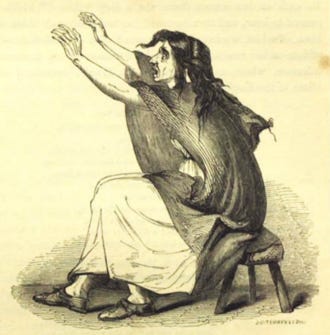
For most people who say they’ve met a banshee, she’s heard rather than seen. The cry can be a soft lament, a keen, or it could be something genuinely uncanny and frightening: a roaring shriek that rushes through the walls and surrounds people, remembered chiefly for how long it went on. She rarely uses words, although my Dad apparently got a great chat out of her. Sometimes, the stories tell us, you could simply order her to stop her crying and she would.
Walk towards the sound she made though, and it only ever retreated.
Who was she warning?
The belief was that the banshee followed particular families, weeping them across to the next world, a kind of guardian spirit attached to a bloodline. Tradition held she belonged only to the truly Gaelic families, the Os and the Macs.
However, take a closer look and that rule collapses. Plenty of Anglo-Norman families had become Gaelicised over the centuries, picking up the Mac or the O, so that complicated things. And she was said to cry for Anglo-Irish families like the Walshes and the Dillons, who had neither. Later tradition even linked banshees to a few families who came with Cromwell. Whatever she once thought about ancient lineages, it looks like she stopped checking backgrounds long ago.
Back to my Dad
I said at the start we have a family banshee story but that’s not the full extent of it because we actually have two. In my Dad’s story, the woman on the road actually offered him her comb. Like any good Leinster child raised on these stories, he knew better than to take it, and politely declined. Maybe that’s why she looked on him kindly and let him go on to feed the pigs. Nobody in the family died after the encounter, so either his uncle was messing with his head, or she’d just wanted a chat and nobody was about to die.
My mother’s family is also supposed to have a banshee of its own, and this one has moved with the times. She has adapted and no longer bothers with the road. If you’re asleep, she floats up to the bedroom window and knocks to herald a death. The last to hear her was my granny, who came down to breakfast one morning announcing a death because she’d heard “the knock” in the night. She slept in an upstairs bedroom. And she never once looked out to see who was knocking because she knew who it had to be.
Her sister died the next day.
I’ll be in Cork on 13 July giving a talk on the Banshee. If you can attend, please do come along. Details here
A bit more on the banshee: Dúchas.ie holds a wealth of folk testimony about the death messenger and Patricia Lysaght’s The Banshee (1986) remains the essential study and informs much of this essay.
Patricia Lysaght, The Banshee: A Study in Beliefs and Legends about the Irish Supernatural Death-Messenger (Dublin: Glendale Press, 1986). On the etymology of bean sídhe / ben síde and the dual sense of sídhe as both “mound” and “otherworld,” see also eDIL s.v. “síd, síth,” https://dil.ie/.
Standish Hayes O’Grady, ed. and trans., Caithréim Thoirdhealbhaigh: The Triumphs of Turlough, 2 vols. (London: Irish Texts Society, 1929).
Lysaght treats the Cathréim as a late, highly stylised text in which the war-goddess badb and the sí-woman are being harmonised, the death-herald becoming attached to particular families in the manner familiar from later tradition; she reads the identification of these badhbh-figures with the land and the O’Brien clan as a shift from the earlier badhbh-texts.
Bo Almqvist, “The Banshee Questionnaire,” Béaloideas 42/44 (1974–76): 88–93, at 88 (circa 150 correspondents) and 89.
Thomas Johnson Westropp, “A Study of Folklore on the Coasts of Connacht, Ireland,” Folklore 32, no. 2 (1921): 101–123. Westropp’s is a period collection and his interpretive framing can be dated but the regional testimony is priceless.
Banshee (Bean Sídhe),” The Schools’ Collection, p. 195, Rathowen (B), Co. Westmeath (roll number 5101, teacher T. McGarry). Informant Mrs Ellen Langan. Dúchas.ie, National Folklore Collection, UCD.
Kristen Mills, “Death, Women, and Power: Theme and Structure in Reicne Fothaid Canainne,” Ériu 68 (2018): 65–98
I have two stories of death messengers. One my own, one my mother's. I'm not sure either could be classified as the Banshee.
My mother describes hearing the shreik of the Banshee the night her grandfather died. She was tending to him, and said it was fierce loud, and surrounded the house, not coming from a single source. They lived on the Mayo coast in the parish of Kilbride, tight on very high cliffs. I often wondered was it the wind coming in off the water and into the cliffs causing that sound. She swears to it, and that it stopped when my great grandfather passed. That would have been likely the late 1930s.
When my mother passed, I was living in Maine. I live on an island, where many people leave for the winter. So, I'm pretty well isolated. I had only just been home, and had spent 6 weeks by her side. I knew she wasn't long for the world, but had to get back here.
We had heard from her care home that things were not looking good. I had my bags packed, and plans to fly back the following day. At 5:15 am, I was woken by a bell ringing. It rang for several minutes. I searched the house. It was definitely coming from inside, but could not find its source. About 20 minutes later I received a call saying that she had passed.
I'm convinced it was she saying her goodbyes. I've often wondered though, could this be classified as the Banshee. It was definitely a death messenger, but can that also be the Banshee? It was as clear as day, but very different from the wailing my mother had heard, and the descriptions in Dr. Lysaght's book.
Thank you for this post. Wish I could be to your talk.
Brilliant, do you think you will do some storytelling festivals in Cork as well