
Looking for the Loud Centuries
How the silence of today hides a much louder past at Monasterboice
You turn off the M1 motorway and follow the signs for the monastery, and the road narrows almost at once. The hedgerows close in on a country lane, the kind where you slow down and hope nobody’s coming the other way. Then, as you crawl around the bends praying you don’t meet a tour bus, the round tower lifts above the trees, uneven at the top where it was damaged, and you know you’ve arrived.
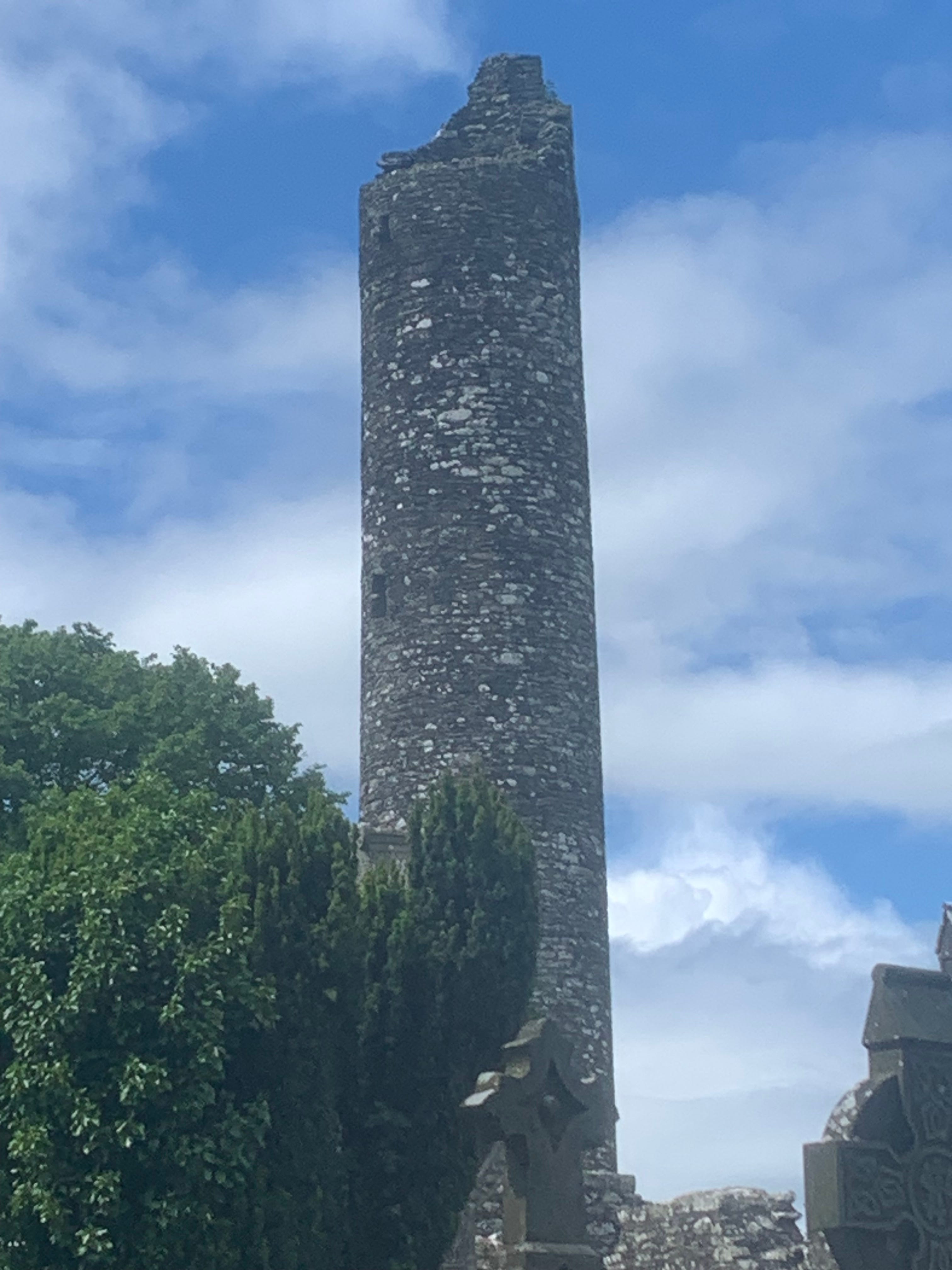
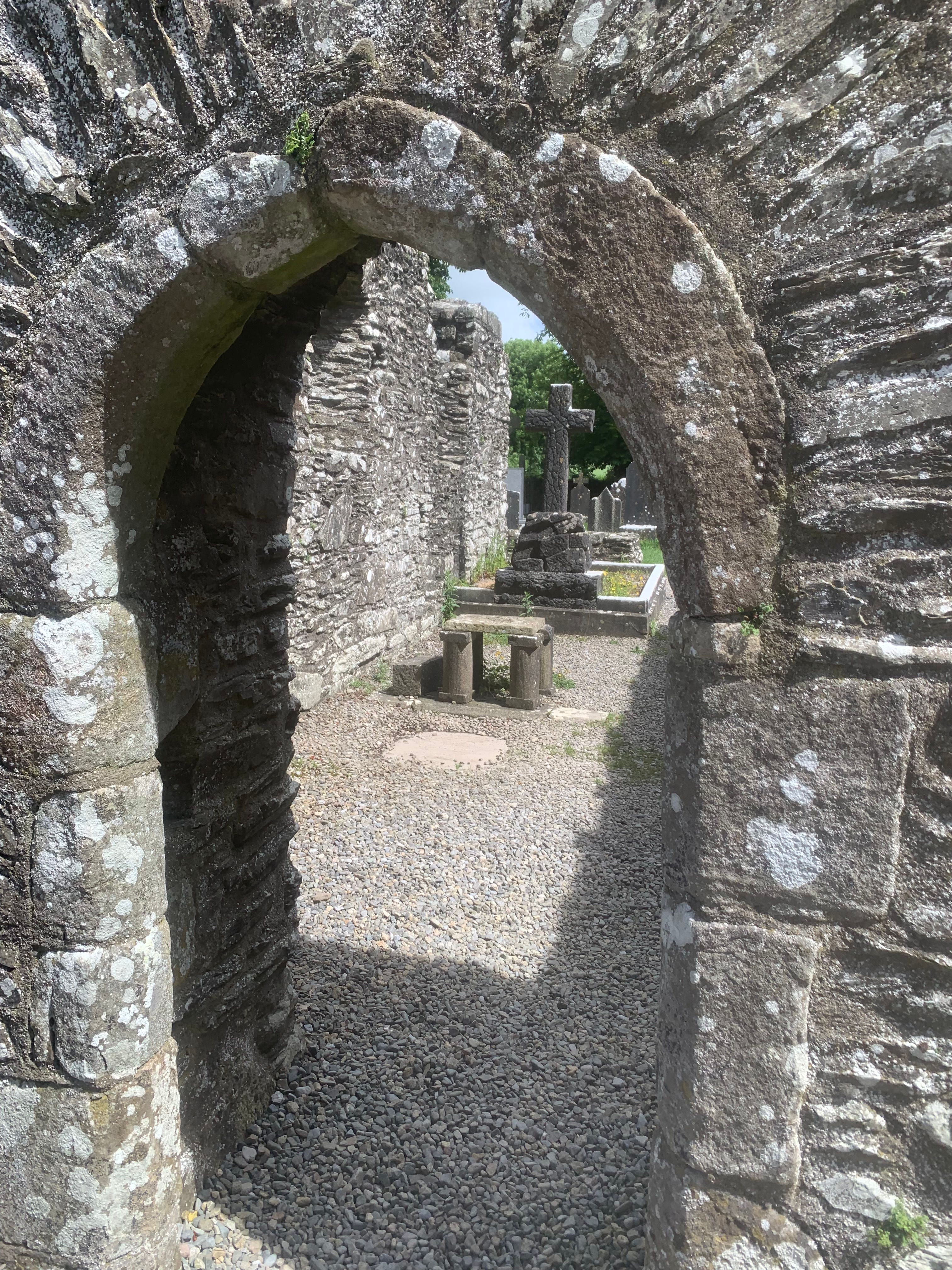
Monasterboice shows itself through the branches, an ancient site sitting in a working graveyard in the middle of what can only really be called rolling farmland, with a small cottage and a slightly wild garden beside it. You park in the little car park across the road and head for the enclosure. You might be wondering why all the guides recommend you come here to this place, as small and off the beaten track as it is. If you arrive on a day without any tour buses then the absolute stillness of the place is striking. But don’t let that fool you. Like many a derelict site, this place was once, in life, very different. And the proof of that comes as you walk through the gate and towards the clustered graves. You stroll up the incline and start to notice some church ruins and then suddenly you’re face to face with some of the finest sculpture early medieval Europe ever produced. Monumental, beautiful stone high crosses. Sculpted over a thousand years ago by masters and still here as testament to an intellectual powerhouse of a monastery that once dominated this corner of Ireland.
The name of the place tells part of that story. In Irish Monasterboice is Mainistir Bhuithe, the monastery of Buithe, named for the saint who founded it and died around 520. Buithe is a shadow now, a figure with a feast day and not much else attached to him, but his place kept his memory alive in a way that turned out to be unusual. Most early Irish church sites took their names from a small stock of recurring elements, some native, some borrowed early from Latin: teach (house), the native one, alongside cill (church, from cella) and díseart (a hermitage from desertum meaning desert), both from Latin. Cill is far and away the commonest. Mainistir, straight from the Latin monasterium, was a rarer choice, and it may have marked out a community that thought of itself as a monastery in a more formal, Continental sense. What’s certain is that this place eventually carried the word so completely that the monks themselves were known simply as the mainistreach, the men of the monastery, as though there were only one.
By the early eighth century Monasterboice was prominent enough to appear regularly in the annals, mostly recording the deaths of its churchmen, which was the medieval equivalent of making the paper obits. The abbots run in a line for nearly four centuries and twenty-two of them have been named, ending with Fergna mac Echtigheirn, who died in 1122. Some of those men were powerful far beyond their corner of county Louth. Eoghan Mainistreach, who died in 834, was abbot of Armagh and Clonard as well, holding the headship of two of the most powerful churches in Ireland alongside his own. The monastery had close ties both to Armagh and to the Columban family of churches, which is to say it sat near the centre of Irish ecclesiastical life rather than off at its edge.
The most famous of them never ran the place at all. Flann Mainistreach, who died in 1056, was a poet and a scholar, a man of learning whose verse on the kings of Tara and the dynasties of Ireland was still being copied into manuscripts centuries after his death. For a small foundation tucked into the Louth drumlins, that’s no small reach. So, it may be quiet today but in its heyday this was a place of cultural and intellectual endeavour. As you stand there today that is hard to imagine. To the modern visitor the monastic ruins sit inside a tidy modern wall, and the eye reads them as the whole site. They weren’t though. Monasterboice belonged to a world where a great monastery was also a proto-town, with farmers and craftworkers and trading families living inside its boundaries, sometimes a resident branch of the local dynasty keeping a house there too.
We know this partly because the place gave up some of its secrets from the air, and later from the ground. Aerial photographs taken from the late 1970s onward picked out faint curving lines in the surrounding fields, the ghosts of enclosure banks long since ploughed flat, and a geophysical survey in 2008 filled in more of the picture. There are as many as four concentric rings, the innermost roughly the line of the present graveyard, the outermost circling an area of perhaps twenty-four hectares. The whole place was in fact a series of enormous enclosures, with the present churchyard sitting in the innermost ring, the holiest ground, and a large settlement spread through the outer ones. Souterrains have turned up here too, the underground stone-lined passages used to store food or to shelter in when trouble came, indicative of settlement.
The monastery was served by craftworkers, farmers and other trades, and before the Vikings arrived a place like this was among the biggest population centres in the country. That’s a different Monasterboice from the one you walk into today. This was not a silent place but a busy and notable settlement, ordered into graded rings of sanctity with the holiest space at the heart of it all and shading outward to the everyday activity of the makers and farmers and workers. Almost all of that bustling place is now completely invisible to the modern visitor.
It sat, too, in a powerful kingdom. This land was part of Brega, the lowland kingdom that ran across Meath, north Dublin and south Louth, ruled by the Síl nÁeda Sláine branch of the southern Uí Néill dynasty. Brega held the best farmland in eastern Ireland, and its rich monastery proved its power and wealth.
The jewels in the crown of the monastery though were its high crosses. They were and still are the glory of the place. Even now they’re monumental, dazzling in their scope and execution. You can read all you like about them beforehand and still not be ready for them when you see them, when you more or less stumble into some of medieval Ireland’s most beautiful art. Three of them stand today, and fragments found over the years suggest there may once have been as many as five, which would be a remarkable number for one site. They were constructed somewhere between 850 and 920.
The finest of the three, and probably the finest high cross in Ireland, is Muiredach’s Cross, also known as the South Cross. It stands a little over five metres, carved on every surface, the sandstone hauled most likely from near Nobber in Meath and worked by a sculptor so accomplished that scholars have given him a name, the Muiredach Master. His hand has been traced across other crosses at Kells, Durrow and Clonmacnoise, all of them holy and powerful places. An inscription on the base asks a prayer for the Muiredach who had the cross made, most probably Muiredach mac Domhnaill, the abbot who died in 923. If you’ve a mind to, you can pause in the quiet of the day and say one for him, a thousand years after he politely requested it.
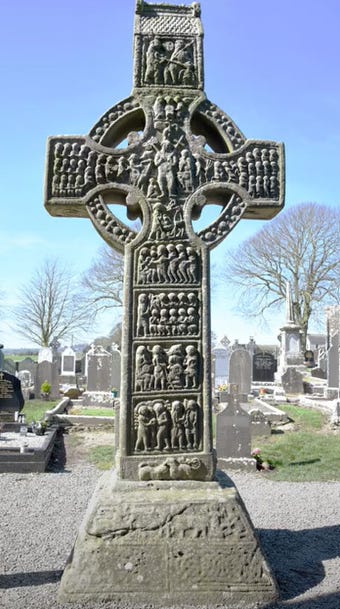
As you look at the cross it helps to remember what these sculptures were for because they were not purely decorative pieces. The panels carry stories from both the Old and New Testaments, set down with the confidence of people who expected their audience to know them and take the lessons therein. They’re often called sermons in stone, monuments set up to teach the faith to a congregation gathered round them, though some scholars think the more crowded scenes were really pitched at a learned monastic audience rather than the ordinary laity. Either way they were meant to be looked at and thought about. They demand a level of engagement and even interrogation that is a marker of the best of art. Remember also that they would have looked very different when they were new. The bare grey sandstone you see now was almost certainly painted, the figures and scenes picked out in colour, so they could be read clearly from a distance. None of that paint survives on the Irish crosses, so we’re left to imagine it.
Even today, shorn of its colour, the cross rewards close inspection. The Crucifixion faces west, the Last Judgement east and you look upwards to see the blessed being shepherded onto one arm and the damned onto the other. Most of us now don’t know our Bible stories the way the people of early medieval Ireland did, and for them this cross must have been a kind of multimedia miracle. Tall and holy and wonderful to behold. Then if you glance down to the base, the Bible stories stop and there are cats. One licks its kitten while another goes after a small bird. Elsewhere two men pull on each other’s beards, and more cats fight and bite each other’s tails. Some have wondered whether the cats were carved to keep children entertained while the adults studied the scripture above. Whatever the reason, there’s humour here, and a knowledge of what people liked to look at. The Master and the monks knew what would capture attention, and when we gather at the base and look at the scenes we carry on a tradition from a thousand years ago.
Some panels of the cross have been difficult for scholars to interpret. One panel shows three figures, a seated Christ handing objects to two men on either side, and there was a long quarrel about whether the scene came from the life of a saint or the life of Christ. It was settled in 1951 by someone looking hard at the thing in the right-hand figure’s grip. Not a scroll, as everyone had assumed, but a key with a T-shaped head, which makes the scene the consecration of Peter set beside the giving of the law to Paul, a composition traced to Carolingian ivories carried into Ireland and rendered here in stone. It’s the kind of detail that reminds us Ireland was a part of a bigger picture. The churchyard may feel isolated now, but it was once within a European-wide religious and cultural network a thousand years ago and more.
Now on to the West Cross, often called the Tall Cross, which is the tallest high cross in Ireland at six and a half metres, and it carries the largest number of figure panels of any cross of its kind. The rope-like garment on the crucified Christ here finds echoes as far afield as a manuscript in St Gall in Switzerland, and the animal scenes on the bases look to Roman and Frankish models for inspiration. The West Cross has a well-preserved head and a damaged stem, and there’s a poignant story attached to the damage: people leaving for emigration during and after the Famine are said to have chipped off a piece to carry with them. It’s folklore rather than fact, but it tells you something about what the place still meant to those forced to leave it.
Here is a little walk around video for you so you can see the scale of it
The third of the surviving crosses, the North Cross, is much plainer, with little decoration, and probably dates to the later eleventh century. Beside it stands a cross-slab carved with the words OR DO RUARCAN, a prayer for Ruarcan, one more small request sent up out of this ground so long ago and somehow still here for us to read.
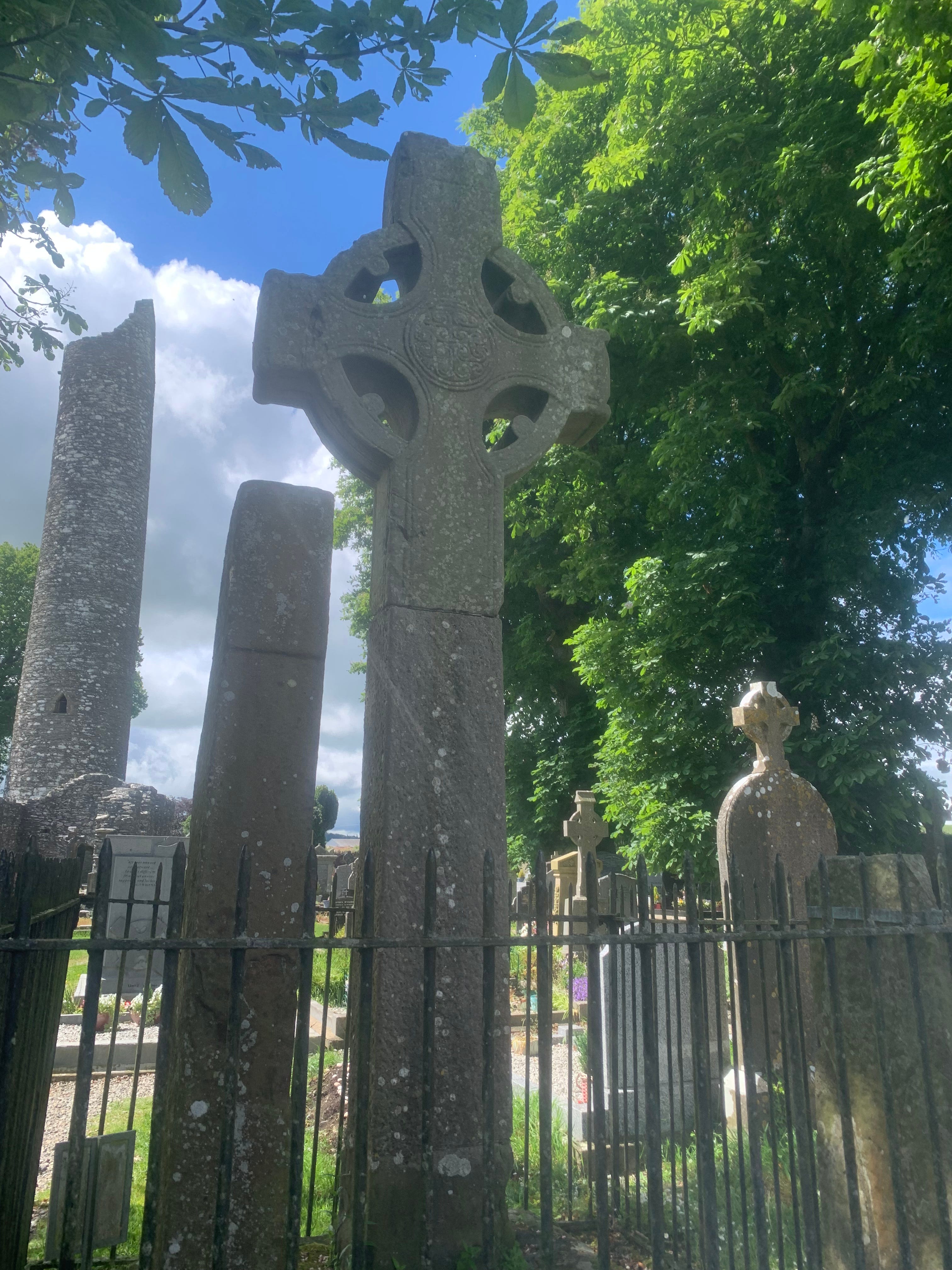
Towards the back of the graveyard is the soaring round tower. These towers are known in Irish as cloigtheach, the bell-house, and that’s much of what they were for, though this one stored the community’s treasures too. It probably went up in the tenth or eleventh century, and it would have worked as a kind of signpost, the tallest thing many people would ever see, visible for miles across the lowland fields. Its doorway is set well above the ground, as these towers always are, made of sandstone and facing east towards the churches, and as you keep looking up you’ll notice the conical cap is long gone. Its treasure-storing function mattered when the Vikings raided the place in 968 but that wasn’t the end of the monastery’s misfortunes. The annals tell us that in 1097 the tower burned, and with it the books and many treasures kept inside. Like so often in Irish history, a violent event meant the loss of an archive. Here a single annalistic entry that opens onto a large loss. Somewhere in that fire and destruction went manuscripts we’ll never read.
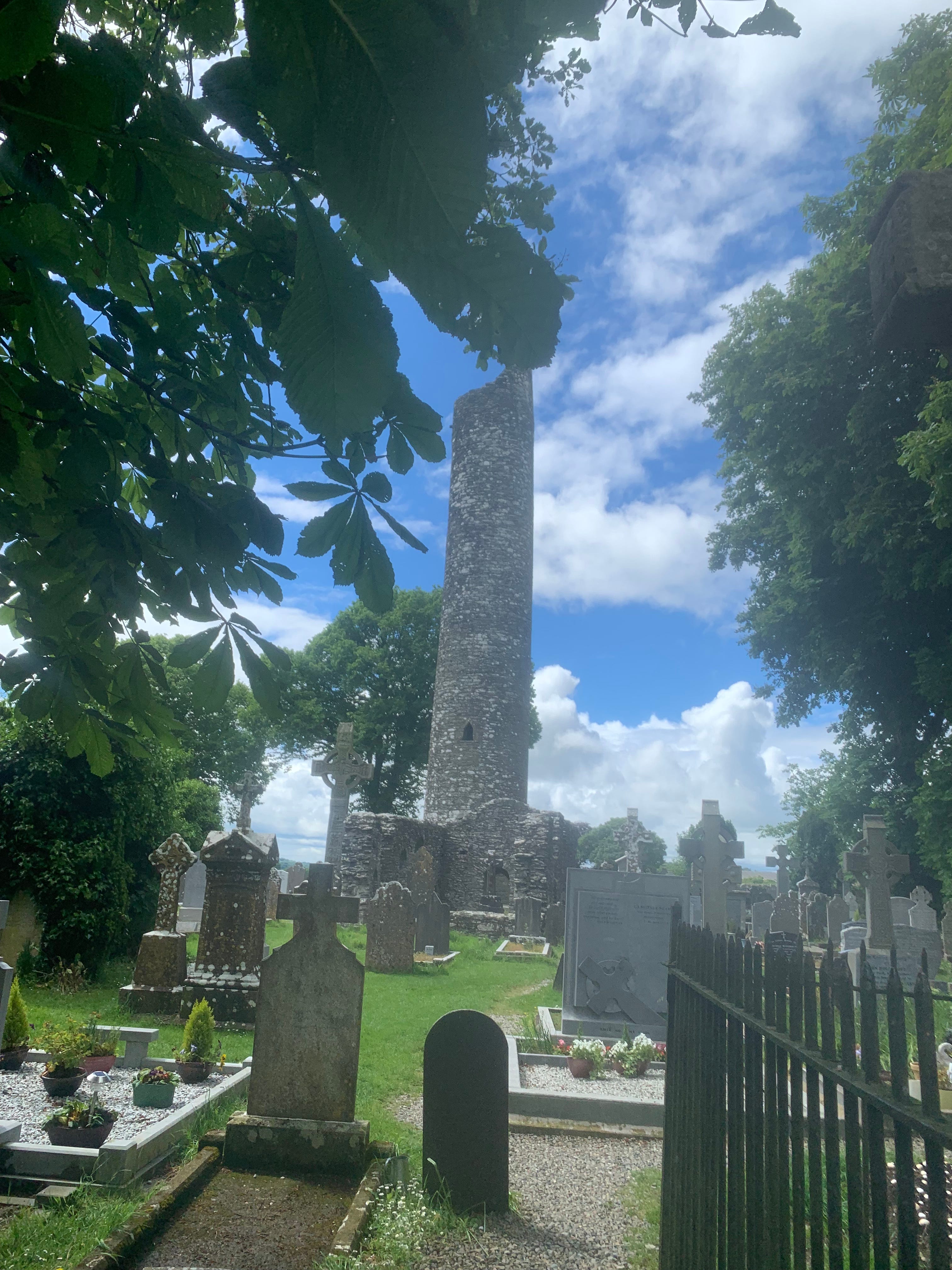
There are two ruined churches here as well. The larger, the South Church, may have gone up in the eleventh century and served as the parish church from the later medieval period until the seventeenth. The smaller North Church may have replaced an earlier shrine to St Buithe, and it was here that the saint’s head, kept in a metal shrine, was said to have been preserved before it was stolen in the sixteenth century.
What ultimately undid Monasterboice wasn’t Vikings or fire, though. It was the twelfth century, and the great reordering of the Irish church. For centuries the Irish church had been built around monasteries like this one, where abbots often mattered more than bishops and church offices tended to stay within a few local families. Reformers, backed by the new church-wide push from Rome, wanted something tidier and more like the rest of Europe, a country carved into territorial dioceses, each under a bishop, and staffed by the new continental religious orders. A series of synods in the first half of the twelfth century redrew the map of Irish church power, and old monastic foundations that didn’t become cathedral seats found themselves suddenly on the outside. Monasterboice was one of the losers. It became neither a diocesan centre nor the home of one of the incoming reforming orders.
Worst of all, the Cistercians founded Mellifont abbey barely three miles to the south-west in 1142, the first house of that order in Ireland, planted by St Malachy from the abbey of Clairvaux through St Bernard’s monks. And Mellifont became known as An Mhainistir Mhór, the great monastery. So the place whose whole identity was wrapped up in being the monastery, the mainistir, watched a newcomer claim the title in its grander form, just down the road.
It didn’t vanish all at once, though. People kept coming, kept praying, and the locals kept burying their dead in the old enclosure even as the buildings fell quiet around them. But the world forgot about this place.
Forgetting can sometimes be a kindness though. The crosses stayed standing and the round tower endured. It was enveloped in quiet for hundreds of years and that seclusion enshrined what was left. But even though the quiet brings benefits it is something to be wary of when we approach and spend time in Monasterboice. Because it reads as the natural condition of the place, a country churchyard that has always been this still. It hasn’t. You’re standing in what was once a town, loud with stock and trade and the business of a rich church, ringed about with banks now ploughed into the fields. A place that produced art and scholarship of international renown. The peace came later and it is the peace of a place that emptied out, not the peace of a place that was always calm.
Go in the early morning if you can, before the coaches start arriving. Let the light come round the tower. Then look at the cats on the cross and maybe murmur a prayer for Muiredach who asked so politely and had such a beautiful cross made to be remembered by.
Enjoy the silence but don’t be fooled by it.
FURTHER READING
Bethada Náem nÉrenn: Lives of Irish Saints, edited by Charles Plummer. Oxford: Clarendon Press, 1922.
Flanagan, Deirdre. “The Christian Impact on Early Ireland: Place-Name Evidence.” In Irland und Europa / Ireland and Europe: Die Kirche im Frühmittelalter, edited by Próinséas Ní Chatháin and Michael Richter. Stuttgart: Klett-Cotta, 1984.
Flanagan, Marie Therese. The Transformation of the Irish Church in the Twelfth Century. Woodbridge: Boydell, 2010.
Harbison, Peter. The High Crosses of Ireland: An Iconographical and Photographic Survey. 3 vols. Bonn: Habelt, 1992.
Stalley, Roger. Irish High Crosses. Dublin: Town House, 1996.
The Annals of Ulster and The Annals of the Four Masters, available through CELT (Corpus of Electronic Texts), celt.ucc.ie.
“Flann Mainistrech.” Dictionary of Irish Biography. Cambridge: Cambridge University Press and the Royal Irish Academy.
Lovely piece that allowed one to step back in time. I will visit next time I go to Ireland. Our world needs centres of deep thought , silence and contemplation more than ever if we are to claw our way back from the dystopian future that seemingly lies ahead for our collective humanity.
A fascinating piece about a beautiful Irish historical site, thank you. I find it remarkable, and very comforting, that the astonishing carvings on the first cross you described have survived in such good condition. We more usually hear about sites such as the much better known Glendalough, so it’s refreshing to see attention being paid to a relatively less familiar site such as Monasterboice!