
Five Astonishing Things About the Voyage of St Brendan the Navigator
What happens when you take a leather boat to Paradise
Every so often the medieval Irish produced a story so improbable that the only reasonable response is to sit back and admire both the nerve as well as the absolute seeming unruliness of it all. But as ever, upon closer inspection, that unruliness masks a very serious intent. In this instance a monk and his companions sail into the Atlantic in a small leather boat to find The Promised Land of the Saints. He and his crew later celebrate Easter on the back of a whale. They’re pelted with molten rock by demons, encounter birds who turn out to be angels with a complicated past, and find Judas Iscariot sitting on a rock in the middle of the ocean, enjoying a brief weekly holiday from hell. And for centuries, for centuries, perfectly serious people wondered whether any of it was literally true.
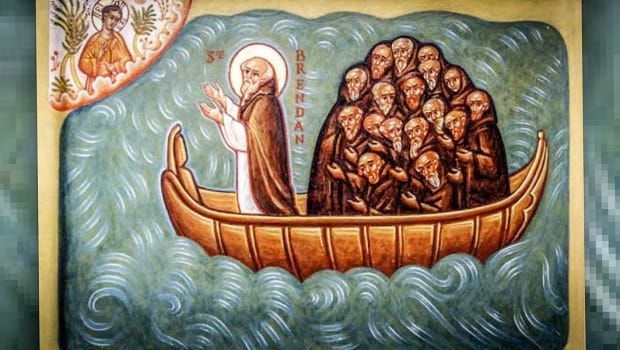
That monk was Brendan of Clonfert, known in the medieval Irish tradition as Brénainn moccu Alti. The genealogies place him among the Ciarraige Luachra of north Kerry, specifically the Alltraige, hence the patronymic Moccu Alti, and the Lives have him born in the district around present-day Tralee sometime around 486.1 He was educated, if the later Lives are to be trusted, under a bishop named Erc and advised at various points by the formidable Íte of Killeedy. The hagiographies have him travelling to Brittany, Wales, and Scotland before founding Cluain Ferta Brénaind (“Brendan’s meadow of the burial mound,” now Clonfert in east Galway) sometime between 558 and 564. Ardfert, in his native Kerry, was his other great foundation.2 His Voyage belongs to a genre of seafaring stories known in Old Irish as an immram where an Irish hero or monk travels across the western sea in search of a mystical paradise or the Land of Promise.
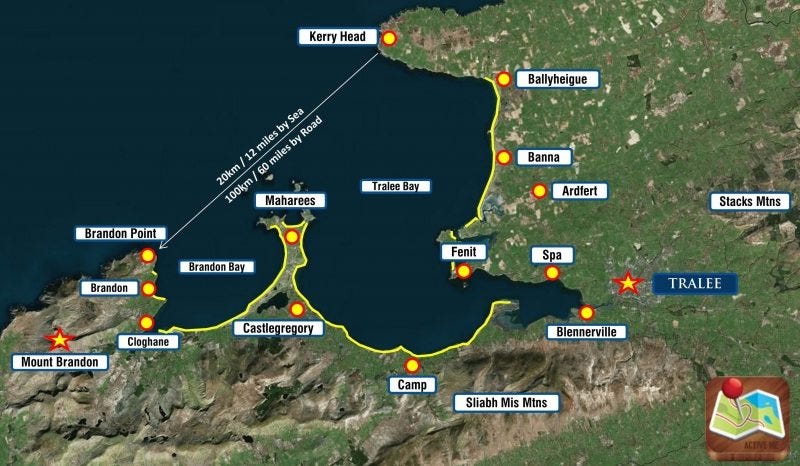
The historical record holds him at arm’s length. Almost everything we have about him comes from sources composed long after his death, which was in 577 or 583, depending on which set of annals you trust. There is one near-contemporary reference worth considering. Adomnán of Iona, writing in the late seventh century, places Brendan on Iona in the company of Comgall of Bangor, Cainnech of Achad Bó, and Cormac the pilgrim-monk, visiting Colum Cille.3 That detail tells us Brendan was a traveller, moving among the great monastic centres of the Irish Sea world. The rest, including the story of the great voyage that made him famous, is much harder to pin down.
The story of the great voyage attached to his name is the Navigatio Sancti Brendani Abbatis (“The Voyage of Saint Brendan the Abbot”), a Latin prose text composed anonymously in the late eighth or early ninth century, either in Ireland or by an Irishman on the Continent.4 It tells of the adventures of Brendan and his monks on their epic seven-year Atlantic journey. It went on to become one of the most widely circulated pieces of writing in medieval Europe, a medieval bestseller. About 125 manuscripts survive, ranging in date from the tenth to the seventeenth century, scattered across western and central Europe.5 The story was retold in languages as varied as Anglo-Norman, Dutch, German, Venetian, Provençal, Catalan, Norse, and English. Caxton included the Brendan life in his English Golden Legend of 1483/4, so it’s among the earliest books produced in that language.
And what a story it is. Here are a few highlights:
1. The monks celebrated Easter on the back of a whale
This is the episode everybody remembers, and it deserves its reputation. Brendan and his monks land on what appears to be an island. They light a fire and start cooking. The “island” begins to move beneath them. It is not, it turns out, land at all, but an enormous sea creature named Jasconius who has been raising his back above the waves every Easter so that Brendan’s crew can celebrate Mass on him, as part of a providential arrangement of which only Brendan is fully informed.
The monks, not knowing of this arrangement, scramble for the boat in considerable alarm. Brendan remains calm. He explains that this has been God’s plan all along and that Jasconius will reappear every Easter for the duration of the seven-year voyage. Whether the monks find this reassuring or not is not recorded.
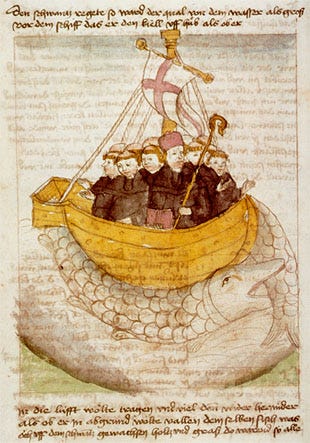
The whale-island is one of the great images of medieval literature, and the Irish were by no means the only people to enjoy it. The motif turns up in Arabic tales, in Norse sagas, in the Old English poem The Whale from the Exeter Book, in the Thousand and One Nights, and eventually, at considerable distance, in Milton’s Paradise Lost, where Satan slumbering on the Norway foam is compared to just such a creature. Whether the Irish got the image from elsewhere or the resemblances reflect some common maritime folklore has never been resolved to anyone’s satisfaction. What the Navigatio gave the motif was its theological dimension. Jasconius isn’t a hazard of Atlantic navigation but a participant in divine providence.
2. Did Brendan get to America?
Nobody has expended more scholarly energy on a less conclusive question than whether Brendan’s monks reached North America before the Norse.
The Navigatio contains descriptions of icebergs, volcanic islands, fogs, vast colonies of seabirds, and other North Atlantic phenomena oddly suggestive of genuine sailing experience somewhere in those waters. In 1976, the explorer Tim Severin built a leather currach to early medieval specifications: forty-nine oxhides tanned in oak, sewn together with nearly two miles of leather thong, over a frame of native ash and oak. He sailed her from Brandon Creek on the Dingle Peninsula towards North America. Thirteen months later, on 26 June 1977, the Brendan made landfall at Peckford Island in Newfoundland, demonstrating that the Atlantic crossing was physically possible in such a vessel.6
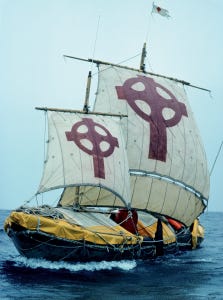
Thing is though, physically possible isn’t the same thing as historically proven. There is no securely dated Irish monastic site anywhere on the American coast. Unlike the Norse settlement at L’Anse aux Meadows in Newfoundland, which you can visit and stand in, there is nothing to dig up to indicate Brendan and his crew landed. Most historians therefore treat the Navigatio as a literary and spiritual text and leave questions of actual geography decorously in the margins.
Early medieval Irish monks though may well have genuinely been out in the Atlantic in ways that modern people tend to underestimate. Some Icelandic sagas state that when the Norse reached Iceland in the late ninth century, they found Irish papar (monks) already in residence. The Íslendingabók and the Landnámabók both record that the monks left behind their books, bells, and croziers rather than cohabit with pagans. Some archaeological finds may also point to wards pre-Norse settlement but it is still not fully agreed.7 The Irish geographer Dicuil, writing in 825, indicated in his Liber de mensura orbis terrae that hermits from Ireland had inhabited the Faroes before the Vikings drove them out, and that Irish monks had been making summer voyages to Thule (almost certainly Iceland) since around 795.8 These were not cautious people or certainly they were busy building a reputation as such which is reflected in sources.
3. The story contains something that looks like genuine sailing knowledge even though it’s not really about sailing
Buried within the miracles and monsters is some practical detail that rewards attention. Brendan’s boat is a skin-covered currach of exactly the type that genuinely existed on the western Irish coast: a wooden frame overlaid with hides, waterproofed, light enough to be carried overland when necessary. The text describes island-hopping, navigation by birds, sea fog, ice, and what sounds in places like volcanic activity. Some of the places described do sound a bit like Iceland and the Faroes so may indicate knowledge of them. The seven year voyage of the monks follows a circular rather than a linear pattern, returning to the same island stations at the same points in the liturgical year.
In fact it has been argued that this repetition is the key to reading the voyage correctly: progress is measured not in miles but in the soul’s advancement towards God.9 The Navigatio is hagiography, not travel writing, and its author wasn’t trying to record a factual story but to expound moral doctrine. Time and space in the text are symbolic throughout. The entire voyage takes seven years, a perfect number. The monks set out with supplies for forty days, as Christ spent forty in the desert. They stay for three days on each island, a Trinitarian number. Every detail carries freight.10
This doesn’t mean that the Atlantic sailing experience embedded in the text is illusory. It means the author was working with real material but transforming it into something else. He was telling a moral tale but grounding it in a reality.
4. The voyage is considerably darker than people remember
The tendency is to recall the weird whale bit and forget the rest, which is a mistake.
Brendan’s monks sail past a volcanic island where demons hurl burning slag and molten rock into the sea around them, hear the screaming of the damned, and lose a brother monk dragged away to hell by devils after he steals a small object from one of the islands. Brendan encounters Judas Iscariot on a rock in the middle of the ocean, enjoying his freezing cold weekly Sunday relief from the burning torments of hell on account of small kindnesses done in his lifetime. The cloth that hangs before him and lashes him in the eyes with every wave, Judas explains, he once gave to a leper, but it was bought with stolen money from the Lord’s purse, so it causes more grief than comfort. The iron hooks tormenting him he had once given to the priests of the Temple. Since those were bought with his own money, they give him some relief from the fish that would otherwise gnaw at him.
It is a peculiar theology, and the Navigatio handles it with more delicacy than you might expect from a text that also features fantastical sea monsters being destroyed by other sea monsters. Think of it in terms of the voyage being an allegory of interior spiritual conflict. The ocean is internal. The islands the monks encounter as they journey around (there are a few including the Island of Birds, the Island of Grapes, Island of Sheep and the Island of Strong Men) are moral states and you encounter many difficulties as you navigate. But God is always there, in the details.
The demons throwing molten rock and poor old Judas having a bit of a holiday in the freezing wet cold of the Atlantic also remain excellent storytelling regardless of your view of the allegorical nature of it all. Encouraging morality in an entertaining way was a medieval winning strategy.
5. Brendan’s island became a cartographic obsession
Saint Brendan and his crew finally reached The Promised Land of the Saints (Saint Brendan’s Island). The island was described as a “wide land full of trees bearing fruit.” They stayed on the island for forty days (symbolic again) and gathered gemstones and fruit before they began their journey home to Ireland. For centuries after, mapmakers marked “Saint Brendan’s Island” in the Atlantic as if it were a verifiable geographical feature. The earliest surviving example is on the Hereford mappa mundi of around 1275 to 1280.11 From there the island is featured in successive maps and drifts further and further westwards as actual knowledge of the Atlantic expanded and the island had to retreat ahead of it. It appears on the Dulcert map of 1339 (where it slides onto the Madeiras), on Battista Beccario’s maps of 1426 and 1435 (“Insulle fortunate sancti brandany”), on Martin Behaim’s globe of 1492 (where it floats far out in the mid-Atlantic), and on into the eighteenth century.
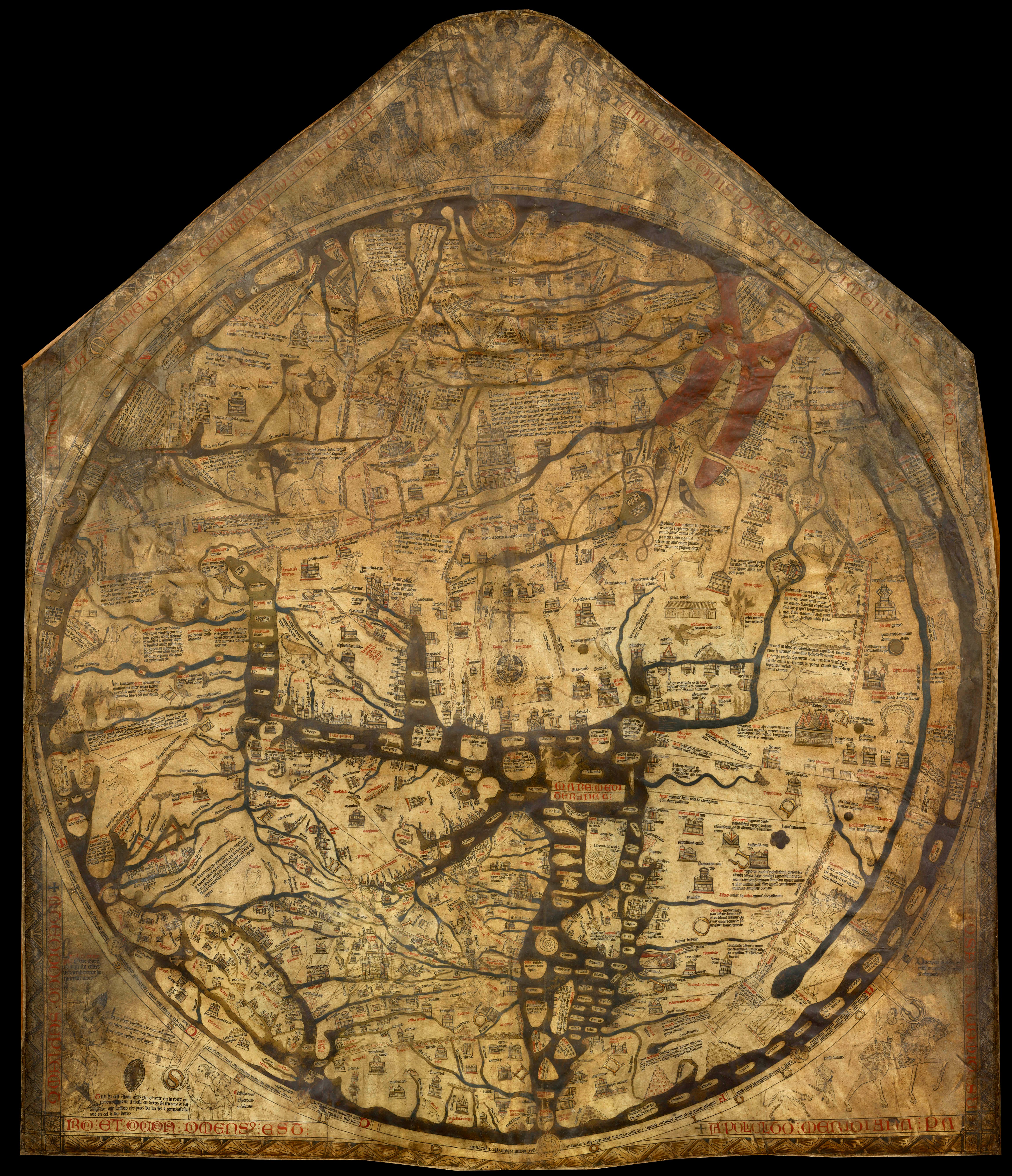
An imaginary island, generated by a text that was itself generated by the peculiarly Irish combination of Atlantic monastic adventurism and theological allegory, quietly shaped the European imagination of what lay beyond the horizon for four hundred years. Not bad for a small leather boat and an anonymous medieval author.
Dictionary of Irish Biography. The Annals of Inisfallen give 486 for his birth; the Annals of Ulster give 484.
Charles Plummer, ed., Vitae Sanctorum Hiberniae, 2 vols. (Oxford: Clarendon Press, 1910), 1:98–151, for the principal Latin Life.
Adomnán of Iona, Vita Sancti Columbae III.17, ed. and trans. Alan Orr Anderson and Marjorie Ogilvie Anderson, Adomnán’s Life of Columba, rev. ed. (Oxford: Clarendon Press, 1991), 206–9. Adomnán was writing c. 697–700.
For a recent reassessment supporting a date in the late eighth century, Jonathan M. Wooding, “The Date of Nauigatio S. Brendani Abbatis,” Studia Hibernica 37 (2011): 9–26.
For a complete manuscript survey, see Glyn S. Burgess and Clara Strijbosch, The Legend of St Brendan: A Critical Bibliography (Dublin: Royal Irish Academy, 2000).
Tim Severin, The Brendan Voyage (London: Hutchinson, 1978), esp. 30–55 on the construction. Landfall was made at Peckford Island, in Musgrave Harbour, Newfoundland, on 26 June 1977; see Ronan McGreevy, “Explorer, writer Tim Severin (80) dies at his home in West Cork,” Irish Times, 19 December 2020. For an assessment of the voyage’s evidentiary value, Seán McGrail, “Brendan’s Boat: Was It Really Possible?” in Burgess and Strijbosch, The Brendan Legend, 197–218.
Dicuil, Liber de mensura orbis terrae VII.11–15, ed. James J. Tierney with contributions by Ludwig Bieler, Scriptores Latini Hiberniae 6 (Dublin: Dublin Institute for Advanced Studies, 1967), 74–78. On Dicuil himself, Marina Smyth, “The Earliest Written Evidence for an Irish View of the World,” in Cultural Identity and Cultural Integration: Ireland and Europe in the Early Middle Ages, ed. Doris Edel (Dublin: Four Courts Press, 1995), 23–44
John D. Anderson, “The Navigatio Brendani: A Medieval Best Seller,” Classical Journal 83, no. 4 (1988): 315–22, at 317–19.
Dorothy Ann Bray, “Allegory in the Navigatio Sancti Brendani,” Viator 26 (1995): 1–10.
Scott D. Westrem, The Hereford Map: A Transcription and Translation of the Legends with Commentary (Turnhout: Brepols, 2001), 364–65 (legend 832). The classic earlier study remains W. H. Babcock, “St. Brendan’s Explorations and Islands,” Geographical Review 8, no. 1 (1919): 37–46.
Hi Gillian = wonderful post! You might enjoy my three-parter on the 14th century illustrated version of the Navigatio. https://roaringwaterjournal.com/2025/07/06/st-brandanus-a-14th-century-graphic-novel-part-1/
Great post; really enjoyed this! I like to believe that Judas's weekend-getaway-isle was Rockall.